
CMFAS Module 4A Key Notes 1
Finance is study of the valuation and management of risk.
There are two components to risk.
1. The time of its revelation.
2. The nature of its randomness.
2. How does one describe the financial markets?
Financial markets can be thought of as supermarkets for risky cash flows. Unlike regular supermarkets where you shop among products on the shelves, financial supermarkets work as organized exchanges, where financial securities are bought and sold in continuous auctions.
3. How to governments finance their deficits?
Most governments need to finance their deficits. To do so they issue government debt. The debt can be short term, in which case we call it a Treasury Bill, which will promise a given cashflow sometime within the next year.
4. What happens when a government debt is long term?
If government debt is long term, over a year, it is typically issued
as government bonds, with annual payments of coupons and a repayment of the face value at the bond maturity. Since governments can always print money, there is no uncertainty about whether you get your money back when you hold a long term government bond.
5. What is considered a more risky security than bonds?
A more risky security is corporate equity, or stocks. A corporate equity gives the owner the right to a dividend from the corporation. The dividend is a function of the profitability of the corporation. Since this profitability is quite variable for
most companies, the cashflows from a stock will be risky.
6. What are the differences between futures and options?
Futures markets are markets where one can fix a price today for a future delivery of some good. Options markets are markets where one can fix a price today for a future contingent delivery of some good.
7. What are the differences between primary and secondary market?
The primary market is at the issue of a security. Treasury securities are often issued to the general public by an auction where anybody can send in bids.
This is then the primary market for treasury securities. When a corporation issues equities for the first time, the Initial Public Offering, this is the primary market for equities.
When securities are traded after they have been issued (in the primary market),
they are said to be traded in the secondary market. In terms of volume and value, the secondary market dwarfs the primary market.
8. Why are secondary markets considered important?
Many do not understand why secondary markets are important, because they only seem to be “zero sum games.” (If somebody makes a gain buying a stock the seller must be a loser.) These people miss some important services that financial markets provide:
• Hedging (risk insurance).
• Intertemporal matching of liquidity needs.
• Price signals to primary market.
9. What is the “no arbitrage” assumption?
It should be impossible to sell for a positive price a portfolio which has zero payoff for sure at all future times. This is also called the “no arbitrage” assumption.
The no arbitrage assumption is intimately connected to the value additivity assumption, since a violation of value additivity will also be a violation of the no free lunch assumption.
10. Are effecient markets systematically biased?
The precision of the market’s beliefs depends on the available
information, but it is never systematically biased. Any systematic biases will be used to make profits above those justified by the risk of a strategy.
11. The firm is held by a number of different creditors such as?
The firm is held by a number of different creditors,
such as equityholders, bondholders, banks and so forth. The value of the creditor’s holdings, called liabilities, must by value additivity and no free lunches add up to the value of the firm.
12. How to define the value of a firm?
We define the value of a firm as the price for which one could sell the stream of cash flows that the assets of the firm generates for the traditional creditors.
The value of the firm is always equal to the sum of the values of the company’s liabilities to the traditional creditors.
13. Who are the traditional creditors?
Traditional creditors are: bondholders, warrantholders, shareholders, banks.
The value of the firm is not necessarily equal to
the price of the assets of the company. This because some of the cash flows go to third parties, in the form of taxes, lawyers and accountants fees and also because it may be advantageous to keep the company alive rather than selling it.
15. What are Closed-end mutual funds?
Closed-end mutual funds are regular companies whose sole purpose it is to invest in other shares. Usually, the shares (of equity) in closed-end mutual funds trade at a discount to the net asset value (the value of the shares the fund holds, less any liabilities to bondholders and/or banks). The discount can be as high as 25%.
16. What are the three possible definitions of the market information?
The way we specify market information makes clear we are really thinking about how we can empirically test the efficient markets hypothesis. To make concrete the notion of information, we usually use three different “information sets,”
-All (private and public) Information
-Public Information
-Past Prices
17. What Does “Correctly Reflected” Mean?
It means that markets use the information available to them in the best possible way to generate its assessment of the current value of a financial security.
18. What are the two important properties of future cash flows?
A basic unit of account in finance is a set of future cash flows. There are two important properties of these cash flows. One, the amounts. Two, the dates at which the amounts are paid.
19. How do you definite the term structure of interest rates?
The plot of spot interest rates (rt) against maturity (t) is called the term structure of interest rates. The term structure can take a multitude of shapes. Typically, it is rising, but it can also be decreasing, or even “humped.”
20. What is the basic decision rule for capital budgeting?
We use the term Capital Budgeting for the valuation and management of investment projects. This goes for any kind of investment project. The basic decision rule is to Invest in any project with a positive Net Present Value
21. How are interest rates useful with regards to perpetuities?
Interest rates can be used to simplify certain calculations. One example is the calculation of a perpetuity. A perpetuity is a sequence of payments each period into indefinite future.
An annuity is an asset that pays a fixed amount each year for a specified finite number of years.
23. How do you calculate a compunding interest?
Compounding refers to the frequency with which interest is added to the principal. To calculate the future value at time t of compounding n times per period at a constant interest rate r we use the formula.
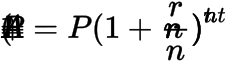
 |
= | final amount |
 |
= | initial principal balance |
 |
= | interest rate |
 |
= | number of times interest applied per time period |
 |
= | number of time periods elapsed |
24. What is a fixed income security?
A fixed income security is a security that offers a predetermined sequence of future payments. The typical fixed income security is a bond.
25. What is the payback period?
The Payback Period of an investment project is defined as the number of years before a project returns its cost. The decision rule involving payback is to accept projects with a payback period shorter than some given period of time.
26. What is the rationale behind the use of the profitability index?
The profitability index of a project is defined as the present value of the project divided by its cost. The decision rule used is to accept projects with a profitability index larger than one. This is equivalent to choosing projects with positive net present values. The rationale behind the use of the profitability index is that it is an attempt to get a relative measure of the desirability of a given project.
27. How to use the Average Accounting Return for project valuation?
The Average Accounting Return is denned as the per-year average accounting earnings after depreciation and taxes, divided by average book value. To use this measure for project valuation one would estimate the future accounting numbers for the project, calculate the accounting earnings for the future and compare the resulting estimate with some “hurdle” accounting rate of return. The problem with the accounting rate of return is that it uses accounting numbers, which usually have very little to do with cash flow. Accounting numbers are easily manipulated, and do not really reflect prices in a marketplace.
28. What is the difference between EVA and MVA?
- EVA (Economic Value Added)
Comparison of operating profit with book value of debt and equity multiplied by “cost of capital.” - MVA (Market Value Added)
Market value of debt and equity less their book value.
29. What is the purpose of the Asset Pricing Theory?
The purpose of Asset Pricing Theory is to understand the pricing of risk. That involves two things:
1. Recognizing risk categories, the ability to classify risky cash flows in “bins” of equal “risk.”
2. Pricing each risk category, finding a price per dollar of expected cash flow.
30. What does the Efficient Markets Hypothesis (EMH) imply?
The Efficient Markets Hypothesis (EMH) explains why there is little predictability in securities prices. The EMH implies that average returns are determined solely by risk. Asset pricing theory determines the content of “risk,” namely covariance with the returns on a diversified benchmark portfolio. Historical data support this proposition across broad categories of assets. However, a closer look reveals ample violations. These violations can be “worked away” by a clever choice of benchmark portfolio, but that does not advance our understanding of financial
markets.